How to Showcase Your Skills Effectively
Master the art of displaying technical and soft skills to pass ATS filters and impress recruiters.
Strategist
Career Advisor
verified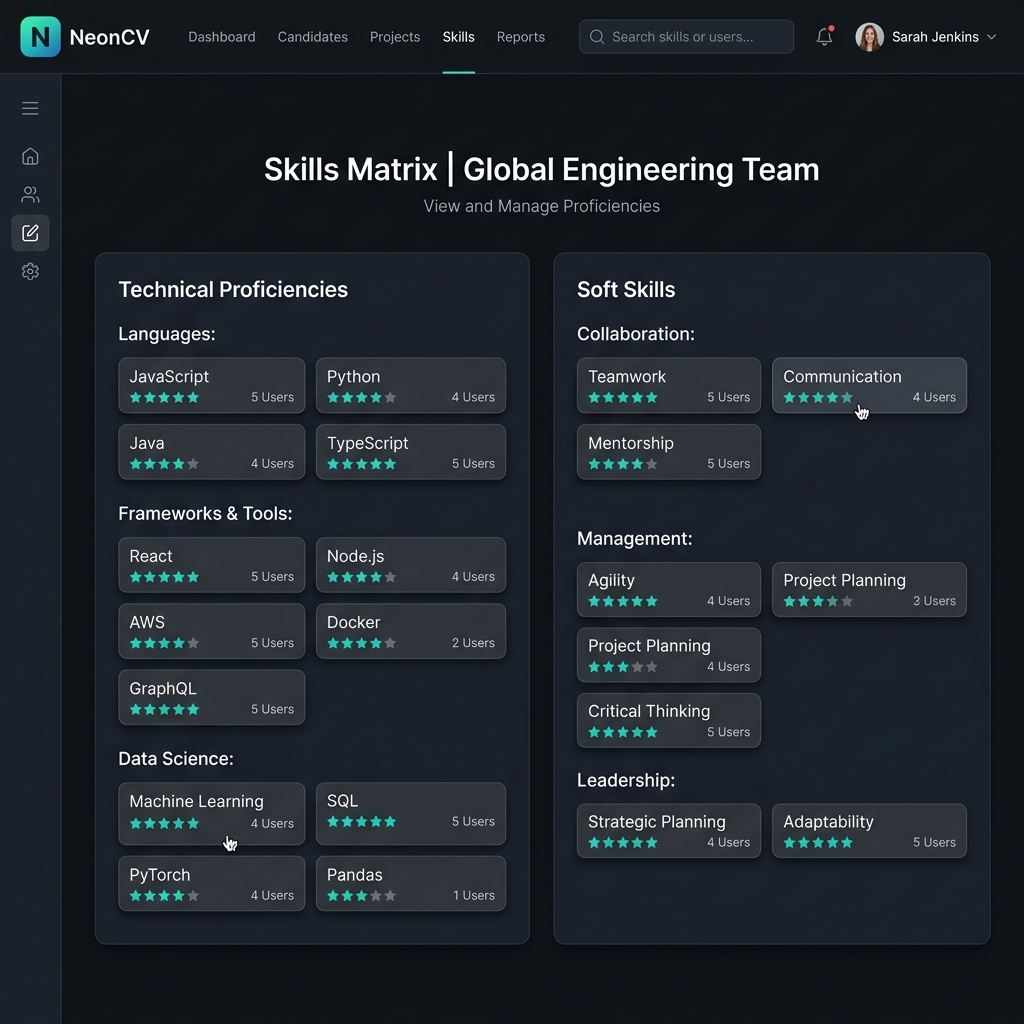
How to Showcase Your Skills Effectively
In a modern job market that is increasingly shifting toward skills-based hiring, simply listing your job titles isn't enough. Your skills section is the engine of your CV—it’s what proves you can actually perform the tasks required.
To land a top-tier role, you must present your competencies with a mix of strategic categorization and hard evidence. Here is how to showcase your skills like a pro.
1. Categorize: Hard vs. Soft Skills
Recruiters look for a balance. Don't dump every skill into one long, unreadable list. Instead, split them into logical groups:
- Hard Skills (Technical): These are teachable, measurable abilities like Python, Adobe Creative Suite, Data Analysis, or Project Management software.
- Soft Skills (Interpersonal): These are "people skills" that dictate how you work, such as Conflict Resolution, Strategic Thinking, and Emotional Intelligence.
- Pro Tip: Use a "Skills Matrix" for technical roles, grouping by "Languages," "Frameworks," and "Tools" to help recruiters find specific proficiencies at a glance.
2. Use the "Show, Don't Tell" Method
Anyone can write "Strong Communicator" on a piece of paper. To make a recruiter believe it, you must provide context within your Work Experience section.
- Instead of: "Experienced in Project Management."
- Try this: "Utilized Agile Project Management to lead a cross-functional team of 10, delivering the project two weeks ahead of schedule."
- The Rule: If you list a skill in your "Skills" section, there should be a corresponding bullet point in your "Experience" section that proves you've used it.
3. Prioritize by Relevance (Keyword Matching)
A 10/10 CV is dynamic. For every application, reorder your skills based on the Job Description.
- Analyze the job ad and highlight the first five skills mentioned.
- Ensure these specific keywords appear in the top half of your CV.
- If the employer emphasizes "Leadership" over "Technical Coding," move your soft skills or management experience higher up.
4. Demonstrate Continuous Learning
The best candidates are "T-Shaped"—deeply skilled in one area but possessing a broad base of general knowledge. Employers value a growth mindset.
- Include Certifications: List recent completions from platforms like Coursera, LinkedIn Learning, or industry-specific bodies.
- The "Learning" Section: If you are currently mastering a new skill (e.g., "AWS Cloud Practitioner - In Progress"), include it. It shows you are proactive and aware of industry trends.
5. Pass the ATS Skills Scan
Applicant Tracking Systems (ATS) are programmed to look for specific nouns and verbs. To ensure your skills are "readable":
- Use Standard Naming: Don't get creative with titles. Use "Social Media Marketing" rather than "Digital Community Wizard."
- Acronyms + Full Terms: Use both (e.g., "Search Engine Optimization (SEO)") to cover all search variations the software might use.
Skills Benchmarking FAQ
How many skills should I list? Aim for 10–15 core skills. Too few looks like a lack of experience; too many dilutes your actual expertise.
Should I use "skill bars" or "star ratings"?No. Visual skill bars (e.g., 80% proficient in Excel) are confusing to human recruiters and often unreadable for ATS software. Use words like "Expert," "Proficient," or "Intermediate" instead.
Are soft skills actually important? Yes. In a world of AI and automation, "human-centric" skills like empathy, adaptability, and critical thinking are often the deciding factor between two equally qualified technical candidates.
Ready to build a skills section that converts? Use NeonCV’s Smart Suggestions to automatically identify the best keywords for your industry.
Post Feedback
Share your thoughts on this article.
Keep Reading
Deep dive into more strategic career engineering.